 1-800-609-2917

 1-800-609-2917
What Is the Best Concealed Access Panel for Finished Drywall Walls?
Posted by Access Doors and Panels on 1st Jul 2026
Selecting the best concealed access panel for drywall walls depends heavily on your aesthetic finish expectations, maintenance accessibility needs, and specific installation requirements.
Modern commercial and luxury residential architecture demands clean, uninterrupted wall planes that maintain visual continuity across entire surfaces. Standard utility doors often compromise these design intentions by leaving highly visible frames, gaps, or protruding latches in plain sight.
Specifying a high-quality flush access panel for drywall allows hidden mechanical, electrical, and plumbing infrastructure to remain fully serviceable without detracting from high-end finishes.
What Are the Key Features of a High-Performance Concealed Drywall Access Panel?
To qualify as a true invisible access panel, the product must integrate natively with the surrounding gypsum board infrastructure rather than sit on top of it.
The engineering behind these panels focuses on hiding the frame's and door leaf's functional components behind industry-standard finishing treatments. This means that the panels can be taped, mudded, skim-coated, painted, or textured to match the surrounding drywall.
Several features make that possible:
- True Flush Appearance: The door panel sits perfectly level with the face of the finished gypsum board, eliminating unsightly surface shadows and uneven joints.
- Drywall Integration: Framing elements feature a perforated flange specifically designed for joint compound application, serving as a permanent mud-in access panel.
- Concealed Latching Mechanisms: Internal hardware removes the need for exterior keys, knobs, or tabs, ensuring a completely hidden access door for drywall walls.
- Long-Term Maintenance Access: Heavy-duty hinges and structural backing allow facility teams to repeatedly open the access door without cracking the surrounding plaster.
Looking to achieve a clean finish on your next project? Head over to our comprehensive drywall access panel category page to browse available sizes and specifications for your finished wall applications.
BA-TLDF vs. BA-IVHFH: Which Concealed Access Door Fits Your Project?
Achieving a seamless drywall finish requires aligning your hardware selections with the specific operational demands of the room or corridor.
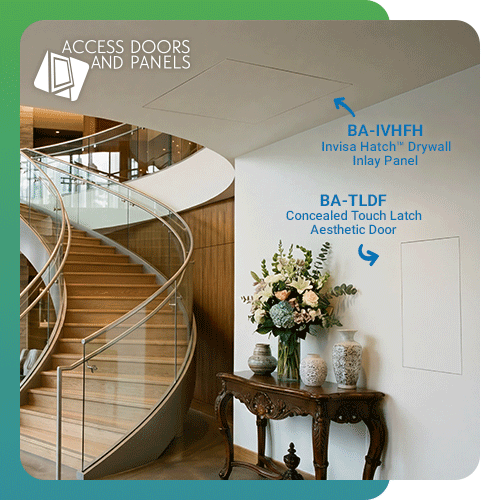
Access Doors and Panels offers two notable concealed drywall access panel solutions: the BA-TLDF and the BA-IVHFH. While both provide clean profiles, they serve distinctly different field requirements.
The BA-TLDF: Streamlined Touch-Latch Functionality
The BA-TLDF is engineered as an efficient, highly adaptable solution for standard high-finish walls requiring routine utility access.
Its primary advantage lies in the integration of specialized touch latch access panel mechanisms that open with simple hand pressure.;This eliminates the need for visible handles, keys, or tools.
The frame features a perforated mud-in flange that allows field installers to tape and finish right up to the edge of the door opening. As a result, the panel blends more naturally into the surrounding drywall surface.
This configuration is optimal for areas housing electrical routing, communication lines, or valves that require frequent access while maintaining a clean appearance. Such areas include office spaces, lobbies, corridors, and boardrooms.
The BA-IVHFH: The Premium, Virtually Invisible Drywall Inlay Solution
When design intent tolerates no visible metal on the wall face, a specialized drywall inlay access panel, such as the BA-IVHFH, is required.
The BA-IVHFH features a recessed door leaf that accepts a matching piece of ½" or ⅝" gypsum board directly into the operable tray. This design uses a robust, fixed-hinge hardware setup that securely supports the additional weight of the integrated drywall panel during operation.
Once taped, mudded, and painted to match the rest of the wall, only a narrow, uniform hairline perimeter reveals that an access point exists.
Available touch-latch, cam-latch, and keyed-lock configurations allow the panel to meet the access and security requirements of different spaces without compromising its concealed appearance.
The BA-IVHFH is ideal for corporate offices, hospitality interiors, healthcare facilities, museums, galleries, luxury residences, and other architecturally sensitive environments.
Technical Specifications Comparison
| Specification | BA-TLDF | BA-IVHFH |
|---|---|---|
| Primary Aesthetic Profile | Flush finished cold-rolled steel door leaf, paintable surface | Inlay drywall face matching the exact wall texture |
| Latching Mechanism | Concealed internal mechanical touch latches | Hidden safety touch latch with fixed-hinge guidance |
| Installation Target | Standard high-end commercial spaces & corridors | Premium feature walls, lobbies, and museums |
| Finishing Method | Mud-in frame flange only; paint applied to door face | Full joint compound, tape, and paint across frame & inlay |
Working with an odd opening or unique project requirements? Share your custom sizing details to find the right fit, or request a quote to discuss your specifications and receive pricing.
Where Are Hidden Access Doors Commonly Used in Commercial Spaces?
Concealed access systems are most commonly used in high-end interiors or in highly visible spaces where aesthetics must be maintained alongside access to building systems.
- Commercial Offices & Executive Boardrooms: Hiding dense network routing switches, automated lighting modules, and smart-board AV controls behind main presentation walls.
- Hospitality & Luxury Retail Interiors: Shielding primary circuit panels, HVAC duct dampers, and zone water shut-offs from public view in upscale boutique showrooms and hotel lobbies.
- Healthcare Facilities: Providing clean, low-profile access points for medical gas shut-offs, zone valves, and wiring trays in administrative wings and public waiting spaces.
- Luxury Residential Projects: Concealing home automation processors, radiant floor heating manifolds, and main water valves within minimalist, baseboard-free hallways.
What Are the Key Pre-Installation Considerations for Concealed Access Panels?
Achieving a perfectly flat, invisible finish requires precise structural planning long before drywall contractors begin mixing joint compound. Improper framing or failure to match the structural depth of the surrounding wall assembly will cause visible lip defects or cracking down the road.
- Structural Framing Clearance: Ensure the rough opening dimensions provide adequate clearance for the panel box frame without warping the metal studs.
- Drywall Thickness Compatibility: Verify whether the chosen model profile perfectly matches a single layer of 5/8" drywall or requires adjustments for double-layer installations.
- Swing Radius and Clearance: Assess the clearance path for fixed-hinge doors to ensure they can open fully without striking permanent fixtures, lighting, or millwork.
- Trade Coordination: Align the mechanical or electrical contractor's layout with the drywall taper's schedule so panels are set plumb before final taping occurs.
Note: If your project calls for structural fire walls, ensure alternative fire-rated drywall panels are installed to meet building code safety partition requirements.
Frequently Asked Questions about Concealed Access Panels
How do you open an invisible access panel without a handle or key?
These systems utilize internal mechanical touch latches. Applying slight pressure to the door's face releases the spring mechanism, allowing the panel to swing forward smoothly.
Can a mud-in access panel prevent cracking at the drywall seams over time?
Yes, provided the frame features a perforated flange. This flange allows joint compound to bond completely through the metal holes, anchoring the assembly directly to the drywall matrix.
Are concealed access doors suitable for ceiling installations?
Many concealed models are cross-compatible. However, ceiling placement requires verifying the latch capacity and hinge retention systems to ensure the door leaf stays securely closed under gravity.
Choosing Your Next Invisible Access Panel
Specifying the best concealed access panel for drywall walls ensures your projects maintain strict structural utility while respecting premium aesthetic layout lines.
Choosing the BA-TLDF provides teams with reliable, tool-free access via a streamlined touch latch frame that disappears seamlessly into high-traffic commercial partitions.
For high-visibility architectural surfaces that tolerate no exposed metal, opting for the premium BA-IVHFH drywall inlay setup delivers a truly uncompromised finish.
Ready to finalize your spec sheet? Talk to our team today about selecting the right concealed access panel for your specific project requirements. Call us on +1-888-327-5471.