 1-800-609-2917

 1-800-609-2917
Which Access Panel Features Matter Most for Energy Efficiency & LEED Goals?
Posted by Access Doors and Panels on 5th Feb 2026

The access panel features that matter most for energy efficiency and LEED goals are good insulation, solid draft control, reliable self-closing and latching, and proper compatibility with both rated and non-rated assemblies.
When those details are overlooked, access points become weak spots in otherwise well-detailed walls and ceilings. That’s when air leakage, thermal bridging, and questions about fire rating tend to surface, especially during reviews, commissioning, or even after the building is occupied.
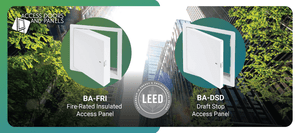
Choosing energy-efficient access panels, like BA-FRI Fire-Rated Insulated Access Panel and BA-DSD Draft Stop Access Panel, helps you protect building envelope integrity and the performance you’ve already designed into interior partitions.
In this article, we’ll explain how access panels affect overall building performance, when to evaluate them during energy and LEED planning, which features to prioritize, and how BA-FRI and BA-DSD can support your energy-conscious projects.
How Do Fire-Rated Assemblies and Energy Goals Intersect?
Fire-rated assemblies and energy goals intersect where an opening must meet both life-safety fire protection requirements and strict thermal and air-control criteria.
In most commercial projects, rated walls and ceilings do double duty. They limit fire and smoke spread between different areas of the building and separate conditioned and unconditioned spaces, corridors and shafts, and mechanical rooms and occupied areas.
Once you introduce an access opening into these assemblies, it must preserve both the fire-resistance rating and the intended energy performance.
Commercial energy standards underline why this is critical. According to Energy Star, air leakage can account for approximately 25% to 40% of the energy used for heating and cooling in typical buildings.
This shows how important it is to carefully detail your access points in fire-rated and insulated assemblies, so they don’t become uncontrolled leakage paths that undermine the overall energy performance.
How Do Access Panels Impact Overall Building Energy Performance?
Access panels impact overall building energy performance by either protecting or weakening the air and thermal layers at critical openings.
If you treat access doors as generic hardware, you risk:
- More air leakage where the frame and door don’t seal tightly.
- Thermal bridges when thin, uninsulated doors sit in otherwise well-insulated walls or ceilings.
- Pressure problems between stairwells, shafts, and conditioned spaces if doors don’t close reliably.
- Finish damage and comfort issues from drafts, temperature swings, or condensation around the opening.
In contrast, energy-efficient access panels support commercial building energy performance through:
- Insulated doors that reduce heat loss or gain at the access point.
- Robust steel construction thathelps the door and frame stay aligned, so gaps don’t appear as the building is used.
- Self-closing, self-latching hardware that makes it more likely the panel will stay shut and perform as designed.
Explore our fire-rated access panels to compare options for your assemblies if you’re planning an energy-efficient or LEED-influenced project.
When Should Access Panels Be Evaluated During Energy and LEED Planning?
Access panels should be evaluated in energy and LEED planning while you’re still defining your building envelope strategy and key assemblies.
When they’re left to the end, access doors can trigger RFIs, redesigns, and tough questions from reviewers and commissioning agents.
To avoid that, your team can:
- Map access points early: Identify where you need access in fire-rated walls, exterior walls, shafts, and ceilings, and classify each location as rated/non-rated and conditioned/unconditioned.
- Align with the Owner’s Project Requirements (OPR) and Basis of Design (BOD): If the OPR or BOD mentions energy targets, low air leakage, or LEED certification, explicitly include access panels under that umbrella.
- Inform energy modeling: Make sure your model assumptions reflect the fact that access doors exist in key assemblies, rather than treating all surfaces as uninterrupted.
- Coordinate access panel selection early: Decide which access panel types you’ll use in each assembly, and coordinate their flanges, insulation, and clearances with firestopping, air barriers, and finishes.
Which Access Panel Features Matter Most for Energy-Efficient Construction?
For energy-efficient construction, the access panel features that matter most are insulation, draft control, reliable closure, durable materials, and appropriate locking options.
Let’s look at these features in detail.
Insulation and Thermal Performance
Use insulated doors in exterior and semi-exposed assemblies, so the access point doesn’t become a cold or hot spot. In addition, make sure the door construction and insulation depth are compatible with the surrounding wall or ceiling assembly, so you maintain consistent thermal continuity.
Air Leakage Reduction and Draft-Stopping
Look for a tight, flush door-to-frame fit and a frame that can be properly sealed to the wall or ceiling. Also, choose panels that are designed to minimize gaps at the perimeter and that integrate cleanly with your air barrier details, so you don’t introduce new leakage paths.
Self-Closing and Self-Latching Hardware
The access doors should automatically return to a fully closed, latched position, without depending on occupants or maintenance staff doing it manually. This is especially important in locations with pressure differences or fire-rated requirements, where self-closing, self-latching mechanisms help maintain both safety and performance by default.
Gasketing and Perimeter Sealing
Where drafts or pressure differences are expected, consider factory-applied gasketing to better control air movement at the panel edges.
In the field, ensure installers seal the flange to the substrate and maintain continuity with the air barrier, so the overall assembly performs as intended.
Durability and Lifecycle Value
Over the long term, heavy-gauge steel frames and doors better resist denting, warping, and misalignment, which helps the panel remain tight and functional through repeated use.
In more demanding environments, stainless steel or corrosion-resistant finishes are also advisable to prevent performance degradation from humidity, chemicals, or outdoor exposure.
Lock and Latch Options
Choose lock and latch options, such as key cylinders, mortise deadbolts, or handle-operated slam latches, to maintain a secure, tight seal at the door.
How Do BA-FRI and BA-DSD Support Energy-Conscious Commercial Projects?
BA-FRI Fire-Rated Insulated Access Panel and BA-DSD Draft Stop Access Panel support energy-conscious commercial projects by giving you targeted solutions for both fire-rated and non-rated assemblies that need airtight, durable access.
Let’s look at each panel in detail.
BA-FRI Fire-Rated Insulated Access Panel
BA-FRI access panel is a fire rated access door that supports energy efficiency. It’s ideal when you need fire rating, insulation, and sustainability documentation in one product.
Here are some of its key features:
- 2-hour fire rating for walls and ceilings.
- 2" mineral wool insulation to reduce heat transfer through the access point.
- Self-closing, self-latching slam latch for code compliance and consistent closure.
- 16-gauge cold rolled steel frame and 20-gauge galvanneal door for strength and durability.
- LEED v4 compliant mineral wool insulation with significant recycled content to support sustainability documentation.
BA-DSD Draft Stop Access Panel
BA-DSD access door is designed for non-rated masonry and gypsum drywall assemblies where airflow and draft control are important.
Its key features include:
- 16-gauge cold rolled steel door with a flush-to-frame design that supports draft control.
- Exposed flange that simplifies installation and braces the opening.
- Continuous piano hinge and two-way access for frequent use in service and maintenance areas.
- Spring-assisted self-closing and self-latching hardware that’s standard on all doors.
- Optional neoprene gasket and a range of lock options (key cylinder cam latch, mortise deadbolt, handle-operated slam latch, cylinder prep) for improved air control, secure closure, and convenient access in service areas.
Need help aligning your access panel features with your energy and LEED goals? Request a quote for BA-FRI or BA-DSD to get project-specific recommendations.
Frequently Asked Questions on LEED Access Panel Considerations
1. Do access panels directly affect LEED points?
Access panels don’t show up as a separate line item on the scorecard, but they influence credits tied to energy performance, envelope commissioning, and materials. When you use insulated, draft-stopping, and LEED-aligned products like BA-FRI, it’s easier to show that your details match the story in your LEED and energy submissions.
2. Are gasketed access panels required for an energy-efficient building?
They’re not always required, but they’re helpful in areas with pressure differences or known drafts, such as stairwells, shafts, and perimeter partitions. Optional neoprene gasketing on BA-DSD, combined with proper installation, can significantly reduce local air leakage in these locations.
3. When should you specify a fire-rated insulated access panel instead of a standard panel?
Specify a fire-rated insulated panel, like BA-FRI, whenever the surrounding assembly is fire-rated and is also part of your thermal or air barrier strategy. This includes rated corridors along the envelope, stairwells, mechanical rooms on the perimeter, and rated ceilings above conditioned spaces.
To Sum It Up
Access panels directly impact energy efficiency and LEED goals because they either reinforce or weaken the assemblies they penetrate. When they’re uninsulated, leaky, or not aligned with fire-rated requirements, they undermine performance and add risk to your project.
However, when you plan access locations early and prioritize features like insulation, draft control, and durable construction, access doors become a reliable part of your energy plan and sustainable construction detailing.
Contact our team or call +1-888-327-5471 to discuss specific access solutions that help you stay aligned with both energy efficiency and code compliance.